Chatbase AI

2dys agoUpdated 2 0 0

Build, deploy, and optimise AI customer support agents with deep analytics, turning conversations into measurable improvements in service and satisfaction.

Date Added:
2026-06-10

What is Chatbase AI Customer Support Agent?

Chatbase is an innovative platform that revolutionises the way businesses approach customer support through the power of artificial intelligence. As companies strive to enhance their customer experiences in a rapidly evolving digital landscape, Chatbase emerges as a crucial tool for organisations seeking to implement intelligent, scalable solutions.

At its core, Chatbase allows teams to create, deploy, and refine AI-powered chat agents that can interact seamlessly with customers. These chat agents are designed to handle a variety of inquiries, providing instant responses to frequently asked questions, troubleshooting common issues, and guiding customers through complex processes. This not only increases customer satisfaction but also frees up human agents to focus on more complex tasks that require a personal touch.

The true strength of Chatbase lies in its advanced analytics capabilities. By analysing interactions and customer behaviour, businesses can gain valuable insights into customer preferences and pain points. This data is instrumental in shaping the chat agents' responses and overall performance, ensuring they consistently meet and exceed customer expectations.

Furthermore, Chatbase's multimodal approach enables its chat agents to engage through various channels, such as websites, social media, and messaging apps, making support accessible wherever customers are. This omnichannel capability ensures a cohesive customer experience that caters to the diverse needs of users in an increasingly interconnected world.

Chatbase is more than just a tool for chat automation; it is a comprehensive solution that elevates customer support through intelligent AI analysis and interaction. By harnessing Chatbase's capabilities, businesses not only improve operational efficiency but also foster deeper, more meaningful connections with their customers.

This article provides a thorough overview of Chatbase’s core functions, practical usage guidance, pricing considerations, real-world application scenarios, a balanced assessment of pros and cons, a survey of competing tools, and a grounded verdict on where it fits within aisoftradar.com’s categorisation framework.
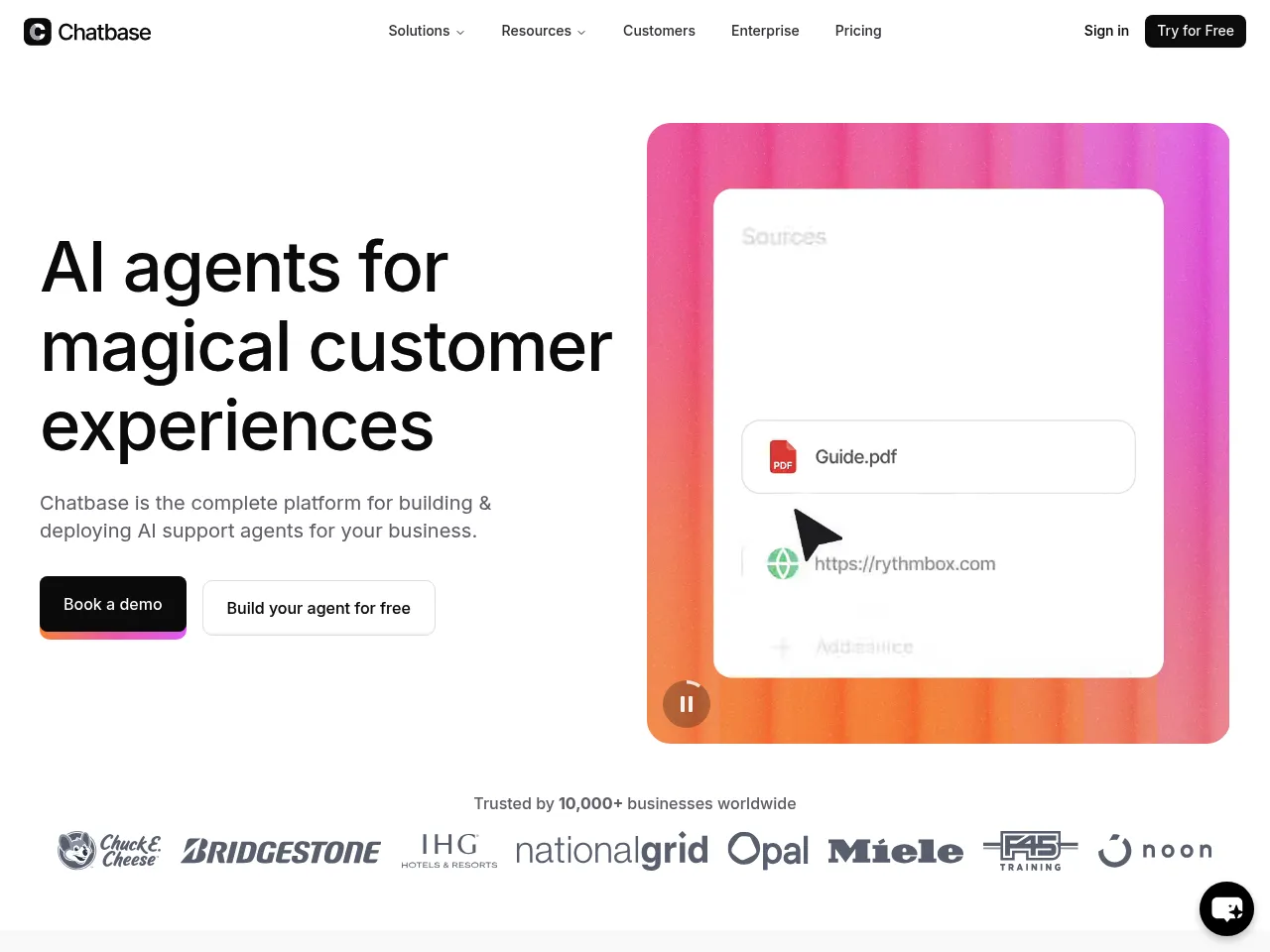
Build, deploy, and optimize AI customer support agents with deep analytics, turning conversations into measurable improvements in service and satisfaction.

Justification: Chatbase is positioned as a platform for building, deploying, and analysing AI-powered customer support agents. It focuses on creating and managing chat-based assistants, monitoring performance, and optimising engagement through advanced analytics and telemetry. This combination (agent creation/deployment plus deep analytics) places it squarely in AI-powered customer support tooling with a strong emphasis on insights and optimisation.

What Chatbase does best? The main functions.

Chatbase’s value proposition rests on three pillars: agent creation and orchestration, deployment across channels, and data-driven optimisation. Each pillar comprises a suite of capabilities that collectively enable organisations to deliver better customer service experiences at scale.

AI agent creation and orchestration.

Chatbase provides a streamlined workflow for designing, configuring, and training AI chat agents tailored for customer support. Users can define intents, entities, escalation paths, and fallback behaviours, then connect these agents to underlying knowledge bases and live agent handoffs. This enables consistent responses, context-aware assistance, and reliable routing for complex inquiries. The platform emphasises reusability, allowing teams to clone and customise agents for different products, languages, or regions, ensuring brand consistency while preserving local relevance.

Deployment and channel integration.

Modern customer support happens across a constellation of touchpoints—web chat widgets, mobile apps, messaging apps, voice channels, and more. Chatbase supports multi-channel deployment, enabling a single agent design to operate across channels with appropriate channel-specific behaviours. This reduces duplication of effort and ensures a cohesive user experience. For organisations operating in regulated industries, Chatbase’s deployment toolkit typically includes secure data handling, access controls, and audit trails to satisfy governance requirements.

Analytics, telemetry, and optimisation.

The true power of Chatbase lies in its analytics stack. It collects rich conversation telemetry, including intent success rates, drop-off points, average handling times, sentiment signals, escalation frequencies, and user satisfaction indicators. This data is transformed into actionable insights through dashboards, funnel analyses, and automated recommendations. Teams can run iterative tests, monitor key metrics, and quickly implement improvements to prompts, flow designs, and escalation criteria. The analytics layer enables data-driven enhancements rather than reliance on intuition alone.

How to use Chatbase.co: practical steps

Getting started with Chatbase typically follows a user-centric workflow that mirrors best practices in AI-driven customer support.

  1. Define goals and success metrics: Before building agents, articulate the primary objectives, such as reducing first-response time, improving resolution rates, or lowering live-agent costs. Establish measurable targets such as response-time thresholds, containment rates, and customer satisfaction scores to guide design decisions.
  2. Design intents and entities: Map common customer questions to intents (e.g., “order status,” “refund policy,” “technical support”) and define entities (order number, product name, region) to capture essential details. This scaffolding helps agents understand user queries and extract relevant data for accurate responses.
  3. Build training data: Create prompts, example dialogues, and fallback strategies. Use a diverse set of training phrases to cover variations in language, tone, and user behaviour. Include edge cases and potential miscommunications to improve resilience.
  4. Train and test agents: Iterate on model prompts, payloads, and conversation flows. Use Chatbase’s sandbox environment to simulate real user interactions, assess performance, and identify gaps in intent recognition or response quality.
  5. Deploy across channels: Once you’re satisfied with performance, deploy your agents to the intended channels. Ensure consistent context handling and escalation paths across web chat, in-app chat, and messaging platforms.
  6. Monitor analytics and run experiments: Regularly review dashboards that track containment, escalation, containment time, and customer satisfaction. Use A/B testing to compare prompt variants, dialogue structures, and knowledge base updates.
  7. Optimise continuously: Based on analytics, refine prompts, update knowledge bases, and adjust escalation triggers. The goal is to reduce average handling time while maintaining or increasing customer satisfaction.

Product pricing – pricing structure guidance

Chatbase typically offers tiered pricing that scales with organisational needs. While exact plan names and pricing may evolve, common patterns include:

  • Entry-level/Hobby or Starter plans with a modest monthly fee, aligned with smaller teams, limited agent counts, and a capped number of monthly interactions or messages.
  • Growth/Professional plans with higher usage limits, more agents, richer analytics features, and expanded access to premium actions or integrations.
  • Enterprise plans with customizable terms, higher quotas, advanced security controls, dedicated support, and enterprise-grade governance features.

Key pricing considerations to verify on the official pricing page:

  • Monthly credits or message quotas per agent or per organisation
  • Number of AI actions or capabilities enabled per agent
  • Data retention periods and telemetry export limits
  • Access to advanced analytics modules, dashboards, and reporting
  • Availability of priority support, onboarding, and training
  • Any additional costs for multi-channel deployments or premium integrations

Important note: Pricing details frequently change as providers run promotions, update plans, or adjust usage caps. For the most accurate and current pricing, check Chatbase’s official pricing page or contact their sales team for a tailored quote.

Application scenarios: where Chatbase shines

Chatbase’s architecture and capabilities make it a compelling option for several practical use cases, especially for organisations prioritising customer support automation and insights.

  • E-commerce and retail support: automating order lookups, returns guidance, product troubleshooting, and policy explanations, while maintaining a high standard of response quality and speed.
  • SaaS customer success and technical support: handling common onboarding questions, product feature explanations, license management, and troubleshooting, with escalation to human agents when needed.
  • Helpdesk and IT support: routing user requests, cataloguing issues, and providing solutions from a centralised knowledge base, with strong reporting on ticket lifecycles.
  • Multilingual customer experiences: delivering consistent responses across languages, assisted by translation capabilities and language-aware routing.
  • Compliance- and governance-focused operations: providing auditable logs and controlled access to sensitive data while maintaining robust customer support workflows.

Pros and cons (balanced evaluation)

Pros

  • Focused on customer support optimisation: Chatbase’s design centres on building and refining support agents to ensure the user journey is efficient and effective.
  • Rich analytics: Deep visibility into metrics such as containment rate, escalation patterns, and conversation quality supports continuous improvement.
  • Flexible deployment: Cross-channel support enables a unified agent experience and reduces operational friction.
  • Collaborative workflow: AI agents can work alongside human agents, enabling smoother handoffs and better overall support experiences.

Cons

  • Complexity for small teams: While powerful, the platform’s breadth may be overwhelming for very small teams or organisations new to AI-driven support.
  • Pricing transparency: Like many enterprise-focused tools, pricing structures can be complex, and exact costs often require a direct quote.
  • Dependence on data quality: The effectiveness of chat agents hinges on the quality and organisation of knowledge bases and training data.
  • Integration effort: For larger organisations with existing ecosystems, integrating multiple data sources and channels can require substantial setup and governance.

Alternative / competing AI tools (brief descriptions)

  • Intercom AI. A customer messaging platform with AI-enabled assistants; strong for live chat and support workflows within a broader customer success platform.
  • Ada. An AI-powered customer care platform focused on automating common support queries with a strong emphasis on agent-assisted workflows.
  • Zendesk AI. Integrates with Zendesk’s ticketing system and supports automated responses, knowledge-base suggestions, and agent-assisted workflows.
  • Freshdesk AI. AI capabilities are embedded in a broader helpdesk suite, emphasising automation of repetitive tasks and intelligent routing.
  • Drift AI. Focuses on conversational marketing and customer support with proactive chat and chat-based lead qualification.
  • LivePerson. Enterprise-grade conversational AI with robust integration options and advanced capabilities for B2B and B2C support.

How Chatbase compares to alternatives

Chatbase distinguishes itself with deep analytics tailored to chat-based customer service and a strong emphasis on agent orchestration and multi-agent workflows. Compared to stand-alone chatbot builders, Chatbase typically offers richer telemetry, more granular performance metrics, and a clearer path to optimisation. Against broad helpdesk suites, Chatbase tends to offer deeper conversational analytics and more specialised capabilities around agent performance and support analytics, though it may require integration efforts with existing ticketing systems.

Final verdict and conclusion

Chatbase.co is a strong choice for organisations looking to elevate their AI-assisted customer support initiatives through rigorous analytics and disciplined agent management. Its strength lies in turning conversations into measurable improvements—containing more queries, reducing escalation time, and driving higher customer satisfaction through data-informed refinements. For teams that already rely on a broader helpdesk or CRM ecosystem, Chatbase can function as a powerful analytics and agent-management layer that complements existing tools rather than replacing them.

Who should consider Chatbase?

  • Mid-sized to large customer support teams seeking advanced analytics to optimise AI agents
  • Organisations implementing multi-channel support with a need for consistent, auditable performance
  • Teams that want to quantify the impact of prompts, flows, and knowledge-base updates on customer outcomes

Who might want alternatives

  • Small businesses with limited budgets or simpler support needs
  • Teams seeking a more generalised all-in-one customer service suite with fewer configuration steps
  • Organisations prioritising a specific channel integration or a different pricing model

Actionable steps before deciding

  1. Review the official pricing page to understand current tiers, credits, and any enterprise terms.
  2. Run a trial or pilot to evaluate agent performance, escalation rates, and analytics quality on representative use cases.
  3. Assess integration capabilities with your existing CRM, ticketing, and messaging platforms.
  4. Check data governance, security certifications, and compliance features relevant to your industry.
  5. Compare the total cost of ownership, including implementation effort and ongoing usage, against competing solutions.

Closing summary

Chatbase.co sits in the AI customer support and chatbot analytics domain, offering a compelling combination of agent creation/orchestration, multi-channel deployment, and rich conversation analytics. Its strongest value lies in turning customer interactions into actionable insights that drive measurable improvements in service quality and efficiency. If your goal is to optimise AI-driven support with robust analytics and auditable performance, Chatbase is a strong candidate to consider adding to your AI tooling catalogue.

Data Statistics

Data Evaluation

Chatbase AIThe number of visitors has reached 2,If you need to check the website's ranking information, you can click " 5118 Data""Aizhan Data""Chinaz data"Enter; based on current website data, We recommend that you refer to Aizhan data as the most accurate,More website valuation factors include: Chatbase AI access speed、Search engine inclusion and index volume、User experience, etc.;Of course, it's necessary to evaluate the value of a website, Ultimately, it depends on your own needs and requirements. Some specific data needs to be found Chatbase AIWe will negotiate with the station manager to provide [the service], such as the IP address of this site、PV、Bounce rate, etc.!

aboutChatbase AISpecial Announcement

This site ?php bloginfo('name'); ?>Provided Chatbase AIAll information originates from the internet, and the accuracy and completeness of external links are not guaranteed. Furthermore, the recipients of these external links are not responsible for their accuracy or completeness. AISoftRadarActual control, in 2026-06-10 3:26 PMAt the time of inclusion, the content on this webpage was compliant and legal. If any content on the webpage becomes illegal or inappropriate later, you can directly contact the website administrator for removal. AISoftRadarWe assume no responsibility.

Relevant Navigation

No comments

none
No comments...