
AI Boom Keeps Tech Stocks Rising
AI Boom Keeps Tech Stocks Rising: What the Latest Quarterly Gains Mean for the Future of AI
AI is reshaping the technology market. Discover which companies are benefiting, why AI infrastructure matters, and what the latest tech rally means for the future of artificial intelligence.
Artificial intelligence is no longer simply a technology trend confined to research laboratories and experimental applications. It has become one of the most important forces shaping the global technology industry, influencing corporate investment, software development, data-centre construction, semiconductor demand and the performance of some of the world's largest technology companies.
The latest quarterly performance of the technology sector provides another indication of how strongly artificial intelligence continues to influence the market. According to a Seeking Alpha report, the technology sector gained approximately 2.75% in the third quarter, supported by strong demand for AI and continued investment in the infrastructure needed to develop and deploy increasingly sophisticated AI systems.
The performance is particularly significant because it demonstrates that the AI boom is extending beyond individual AI applications. Increasingly, investors are looking at the broader ecosystem surrounding artificial intelligence, from processors and networking equipment to cloud computing, data management and enterprise software.
For readers interested in the AI industry, this raises an important question: Is AI becoming a permanent driver of technology-sector growth, or are markets simply experiencing another temporary technology boom?
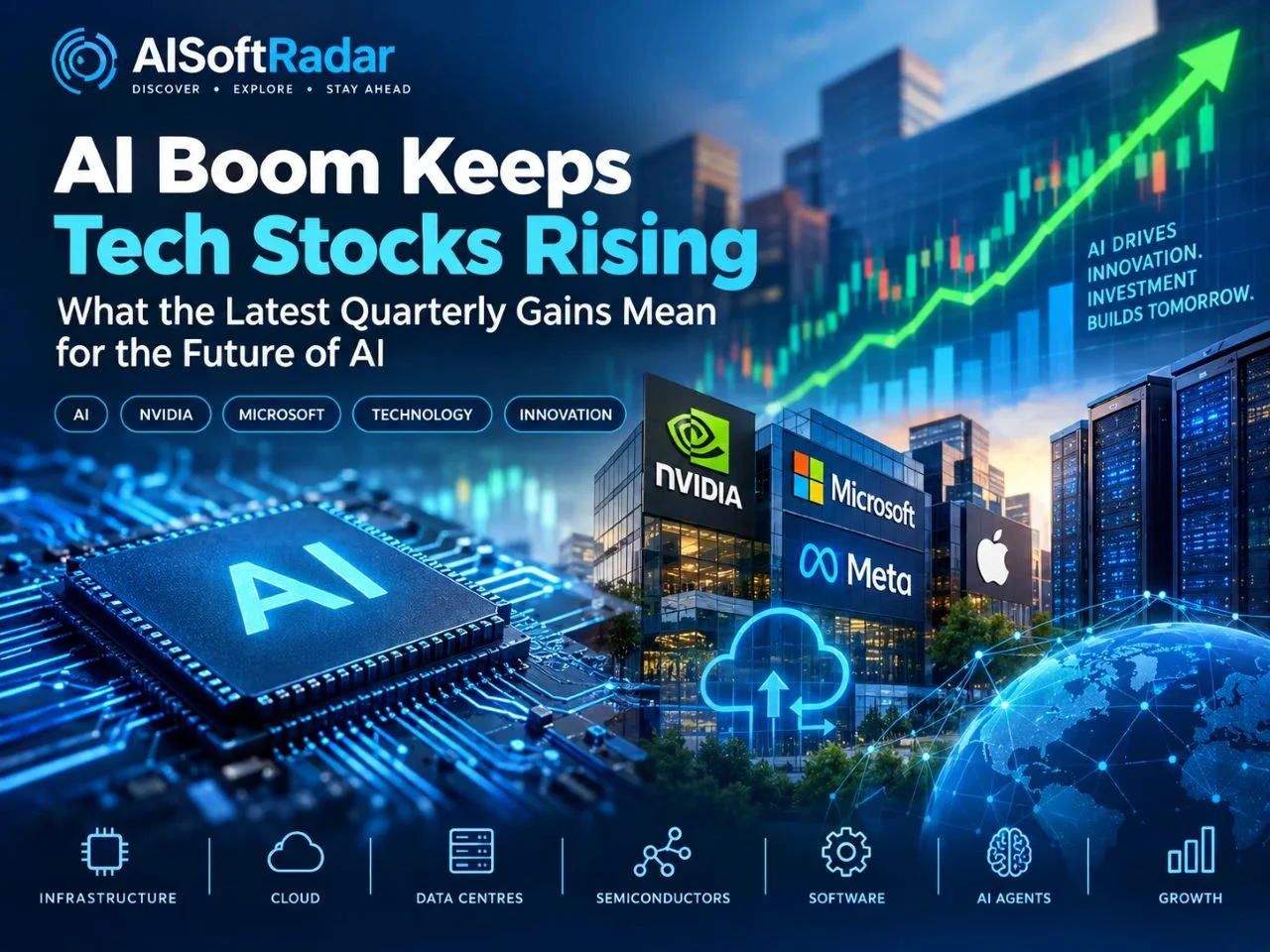
AI remains at the centre of technology-sector momentum
The latest results suggest that artificial intelligence remains one of the strongest themes influencing technology companies. Several major technology companies recorded substantial gains during the quarter. NVIDIA rose approximately 14.13%, Microsoft gained 37.5%, Meta Platforms increased 28.74%, and Apple advanced 15.08%, according to the report.
Although these companies have different business models, AI increasingly forms part of their long-term strategies. NVIDIA is perhaps the clearest example. Its importance to the AI economy comes from its hardware and computing platforms, which support the training and operation of advanced AI models.
Microsoft, meanwhile, has been integrating AI across cloud computing, productivity software and enterprise applications. Meta has been investing heavily in AI systems, recommendation technologies and AI assistants, while Apple is incorporating AI capabilities into its broader device and software ecosystem.
The significance of these companies lies in how they demonstrate how AI is affecting virtually every layer of the technology industry. AI is therefore becoming less of an isolated product category and more of an industry-wide infrastructure and innovation layer.
The AI infrastructure economy is expanding
One of the most important developments behind the current AI momentum is the enormous investment required to support modern artificial intelligence. Large AI models require significant computing power, data storage capacity, networking infrastructure, and energy. Consequently, the AI economy includes considerably more than companies developing AI applications. This creates opportunities for businesses providing the infrastructure necessary to operate AI systems.
The quarterly technology performance illustrates this broader trend. Everpure was reported as the strongest performer in the technology sector during the quarter, gaining more than 80%. Hewlett-Packard Enterprise also recorded a gain of approximately 57%, while Accenture rose by roughly 56%. These performances highlight an important development: AI infrastructure is becoming an investment theme in its own right.
For example, Hewlett Packard Enterprise's performance was associated with strong demand for AI-related infrastructure and networking. The company reportedly had a substantial AI backlog, while AI data-centre opportunities contributed to expectations surrounding future growth.
This demonstrates why understanding the AI industry requires looking beyond familiar AI applications. The companies benefiting from AI may include cloud providers, chip manufacturers, networking companies, cybersecurity firms, data-management businesses, consulting organisations and software developers.
The next phase of AI may be about agents
Another development attracting attention is the increasing importance of AI agents. Traditional generative AI applications generally respond to prompts. AI agents aim to go further by performing sequences of actions, interacting with software systems and helping users accomplish objectives with greater autonomy. The Seeking Alpha analysis points to growing attention to personal agents, including Meta's Muse, as a potential factor shaping the next phase of the AI market.
This transition could have significant implications for the software industry. Instead of users opening multiple applications and manually moving information between them, AI agents could increasingly serve as the interface through which people interact with digital services.
Imagine asking an AI system to analyse a collection of documents, identify important information, prepare a report and organise the results. Rather than simply generating text, an agent could potentially coordinate several software tools to complete the workflow. This is one reason AI agents are becoming an important area for developers and technology companies.
What does the AI boom mean for software companies?
The rapid development of AI also creates both opportunities and risks for software businesses. On the one hand, AI can help software companies develop new products, automate workflows, and provide customers with more intelligent services.
On the other hand, AI may disrupt established software business models. If an AI agent can perform tasks that previously required several specialised applications, some conventional software products may face increasing competition.
This explains why investors are paying close attention to which software companies are successfully integrating AI into their products. The question is no longer simply whether a company uses artificial intelligence. Instead, the more important questions are:
- Does AI create measurable value for customers?
- Does the technology increase revenue or reduce costs?
- Can the company scale its AI products profitably?
- Does the business possess proprietary data, infrastructure or technology that provides a sustainable advantage?
These questions will become increasingly important as the AI market matures.
AI infrastructure versus AI applications
The current technology rally also highlights the difference between AI infrastructure and AI applications. AI infrastructure consists of the technologies required to develop and operate AI systems. This includes processors, servers, cloud platforms, networking, storage, data centres and development platforms.
AI applications sit closer to the end user. These include AI writing tools, image generators, coding assistants, research platforms, customer service systems, productivity applications, and specialised professional software.
AISoftRadar's existing structure reflects this expanding ecosystem, with categories covering AI software development, engineering infrastructure, business intelligence, automation, content creation, data and analytics, education and productivity applications.
This distinction is increasingly useful for understanding where value is being created. An AI application may become popular quickly, but the infrastructure supporting thousands or millions of AI applications could represent an even broader long-term opportunity.
Why AI demand could remain strong
There are several reasons why AI momentum could continue.
- First, businesses are still in the early stages of integrating AI into their operations. Many organisations have experimented with generative AI but have yet to fully integrate it into core business processes.
- Second, AI models are becoming increasingly capable. Improvements in reasoning, multimodal systems, coding and autonomous agents are expanding the range of tasks that AI can potentially perform.
- Third, companies are investing in the infrastructure necessary to support these capabilities.
- Finally, competition among technology companies is accelerating AI investment.
The result is a feedback loop: better AI creates new applications; new applications generate demand for computing infrastructure; infrastructure investment enables more capable AI; and increasingly capable AI creates additional commercial opportunities.
But the AI boom is not without risks
The strong performance of technology companies should not be interpreted as evidence that every AI company will succeed.
- AI-related valuations can become extremely high when investor expectations rise rapidly. Companies must eventually demonstrate that AI investments can generate sustainable revenue and profits.
- Infrastructure companies also face challenges related to capital expenditure, supply chains, energy consumption, and technological competition.
There is another important issue: execution.
- A company may announce a large AI project or secure a substantial backlog, but investors ultimately need to see that the company can deliver the technology, manage costs and convert demand into sustainable financial performance.
- The Seeking Alpha analysis itself highlights this issue when discussing companies with significant AI-related expectations. Strong demand creates opportunities, but businesses must still execute effectively to turn those opportunities into long-term results.
The AI market is becoming broader
Perhaps the most important conclusion from the latest quarterly performance is that the AI economy is becoming considerably broader. The early AI boom was heavily associated with companies producing advanced chips and developing large language models. Today, the ecosystem includes:
- AI infrastructure
- Cloud computing
- Semiconductors
- Data centres
- Networking
- Enterprise software
- AI agents
- Cybersecurity
- Automation
- Data analytics
- AI-powered productivity
- AI development platforms
- Professional AI applications
This broader ecosystem creates opportunities for thousands of technology companies. It also makes AI increasingly relevant to businesses that would not traditionally describe themselves as AI companies.
A consulting firm can use AI to transform its services. A cybersecurity provider can use AI for threat detection. A software company can embed AI into its products. A data management company can optimise data for AI workloads. In other words, AI is increasingly becoming a general-purpose technology rather than a standalone industry.
What the latest technology gains mean for AI users
For consumers, developers, and businesses, continued investment in AI infrastructure could ultimately lead to better, more capable AI tools. Greater computing capacity can support more sophisticated models. Improved infrastructure can potentially reduce latency and improve reliability. Increased competition can encourage companies to develop better products.
For businesses, the expanding AI ecosystem also means there are more tools to evaluate. Instead of asking whether an organisation should “use AI,” businesses increasingly need to determine which AI tools are appropriate for specific workflows. That is where AI directories and technology discovery platforms can play an important role.
AISoftRadar, for example, categorises AI products across areas such as content creation, business and marketing, data and analytics, education, engineering infrastructure, software development, automation, and productivity. As the AI ecosystem continues to expand, structured discovery and comparison will become increasingly valuable.
The bigger picture
The latest quarterly technology performance reinforces a trend that has been developing for several years: artificial intelligence is becoming deeply embedded in the technology economy. The approximately 2.75% quarterly gain in the technology sector is only one measure of this transformation. More significant is the underlying shift in where companies and investors are directing attention and capital.
AI is influencing hardware, cloud computing, enterprise software, data infrastructure and digital services simultaneously. The next stage of the AI revolution may therefore be less about whether artificial intelligence will transform technology and more about which companies can successfully turn AI investment into sustainable innovation and measurable value.
- For technology businesses, developers and users, this creates an increasingly competitive environment.
- For the AI industry, however, it also represents an enormous opportunity.
The AI boom is evolving from a fascination with individual models and chatbots into a much larger technological ecosystem encompassing infrastructure, applications, agents, automation and enterprise transformation.
The latest quarterly technology gains suggest that this transformation is still gathering momentum. The AI revolution is no longer just about building intelligent models. It is about building the infrastructure, software and businesses that will make intelligent systems part of everyday digital life.
Sources and context
This article is an original analysis based primarily on the referenced Seeking Alpha report, with additional context from current technology-market reporting. The underlying report identifies continued AI demand and infrastructure investment as important contributors to the technology sector's quarterly performance. Recent market reports similarly indicate that AI-related companies and infrastructure remain major drivers of technology market performance.
© Copyright notes
The copyright of the article belongs to the author, please do not reprint without permission.
Related posts




No comments...