
Typewise AI
Enterprise-grade AI customer service platform that cuts handling time 50 %. Book a demo – Typewise.
LOADING
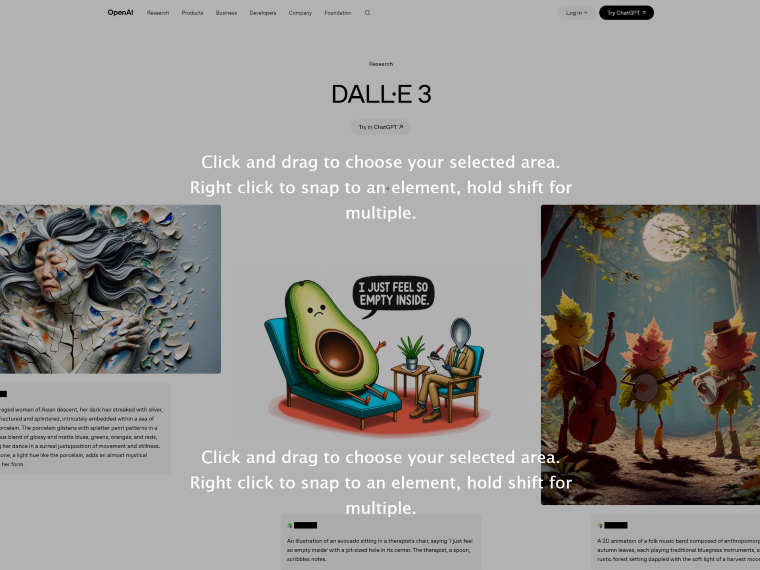
Experience the future of creativity with DALL·E 3 by OpenAI. Transform nuanced text prompts into high-fidelity, exceptionally accurate images with ease today.
 DALL·E
DALL·E is a text-to-image artificial intelligence (AI) system developed by OpenAI. It generates realistic or stylised images from natural-language prompts, allowing users to visualise concepts, scenes, and designs described in text. DALL·E represents a major advance in generative AI, bridging language understanding and visual creativity.
DALL·E builds on a large language model architecture trained on text-image pairs to learn visual concepts and relationships. Later iterations, such as DALL·E 2 and DALL·E 3, use diffusion and transformer-based techniques to refine image realism and alignment with textual input. The model converts descriptive text into image embeddings, which guide the generation of high-fidelity visual outputs.
DALL·E enables artists, designers, educators, and businesses to rapidly prototype visuals. It has influenced digital art, advertising, and concept design workflows, demonstrating the potential of multimodal AI systems. Its ability to interpret complex linguistic cues into coherent imagery highlights the convergence of visual and language models in AI research.
The system’s use raises questions around copyright, bias in training data, and responsible image synthesis. OpenAI introduced moderation filters and usage policies to prevent the generation of harmful or deceptive content while promoting creative, educational, and professional uses.
This site ?php bloginfo('name'); ?>Provided DALL·EAll information originates from the internet, and the accuracy and completeness of external links are not guaranteed. Furthermore, the recipients of these external links are not responsible for their accuracy or completeness. AISoftRadarActual control, in 2026-04-24 9:53 PMAt the time of inclusion, the content on this webpage was compliant and legal. If any content on the webpage becomes illegal or inappropriate later, you can directly contact the website administrator for removal. AISoftRadarWe assume no responsibility.